Yearly Archives: 2014

Japanese Counters for Dummies: they’re easier when you know how!

Ippiki, nihiki, sanbiki…

Japanese counters can seem very difficult at first. You can’t just say “two pencils”, “seven cats” or “ten sheets of paper” the way you can in most languages. You need to know the counter for long round things, small animals and thin flat things respectively.

Not only that, but the pronunciation of the counter changes depending on what number it is used with. The counter for small animals is called hiki but in fact:

1 cat is ippiki
2 cats are nihiki
3 cats are sanbiki
4 cats are yonhiki
5 cats are gohiki
6 cats are roppiki
7 cats are shichihiki or nanahiki
8 cats are happiki
9 cats are kyuuhiki
10 cats are juppiki

And then different counters have different patterns of sound-change.

How Counters’ Sound Patterns Transform

It looks crazy, but in fact it is a lot simpler than it seems. Once you learn how it works you will be able to figure out how nearly any counter sounds for any number.

Look at the sub-heading above and commit it to memory. Here, I’ll give it to you again:

How Counters’ Sound Patterns Transform

You need to remember this phrase. Why? Because actually there are only five types of transforming counter (only?… no don’t panic, I’m going to help you). They are counters that start with the consonantal sounds H, K, S, P and T. That is why you should remember that phrase – How Kounters’ Sound Patterns Transform.

Or, if it is easier, you can remember this way: it is the “hard”-consonant counters that transform, not the “soft”-consonant ones like mai, rin, wa and bu. This makes even more sense when you see how they work, since (with a single maverick exception) they always transform by sharpening or doubling the hard sound – you actually can’t double soft consonants in Japanese. You never see a small tsu before m, b, or w.

Now, once you know that, you will be pleased to learn that the transformations are very regular. What throws people, I think, is that single maverick we spoke of before. H-row sounds turn to the B-equivalent when paired with san (as in sanbiki)*. But actually that is the only major irregularity.

Other than that all the HKSPT counters modify in the same way. In a few cases the modification is optional, but you can always use it without fearing to make a mistake.

So, leaving out the H row for a moment, all the other mutating counters  (K,S,P,T) follow the same pattern:

1. They all keep their base value for all numbers other than one, six, eight and ten (jump from one to six, then every alternate number).

2. As for those four numbers, they all do the same thing:

They simply drop the second syllable of the number and double the first consonant of the counter. So ni-ko and san-ko but ikko rather than ichi-ko and jukko rather than juu-ko.

The only regular exception to this is that the S and T counters don’t mutate for 6 (roku) – i.e. no ross- or rott-.

The H-row is really less puzzling than it seems too. It only changes to the sounds that are made with the H-row by adding diacritical marks so, in the case of ひき hiki, it becomes びき biki (for that maverick san only) and っぴき ppiki for the regular doubled-consonant numbers, one, six, eight and ten. Since you couldn’t actually have hhiki, that isn’t very hard to remember.

Now I won’t pretend there aren’t a few other irregularities with counters (hun, the counter for minutes, for example doesn’t get the b-mutation on 3, but is sanpun rather than sanbun). But this pattern will guide you through most of the ones you are going to use. Even Japanese people mostly don’t use the more obscure counters.

The important thing to realize is that it is a pattern that works nearly all the time, not just a set of confusing random sound-changes. And if the counter does not begin with H,K,S,P or T, it will not have sound-changes at all.

Remember that you don’t need counters if you use the native Japanese counting system – hitotsu, futatsu mittsu. However you should know and use the basic counters like hon, hiki, hai, mai, ko, etc

If you work through the explanation on this page (it sounds a bit more complicated in text than it really is), the pattern of the sound changes should fall into place for you and the whole thing will feel much more intuitive.

がんばってください!
____
* There is a sound-logic to the san-b transformation too, but for our practical purpose here it is simpler just to think of it as a maverick.

Denshi Jisho Review: the Next Generation

We review the next generation of Denshi Jisho, currently in beta.

One of our major online resources, Denshi Jisho, is changing. The new version, currently in beta, is a radical overhaul. It looks nothing like the green and friendly Jisho that we are all familiar with. Is this update a big improvement or a disappointment?

Let’s see what it looks like (click for enlarged view if you wish):
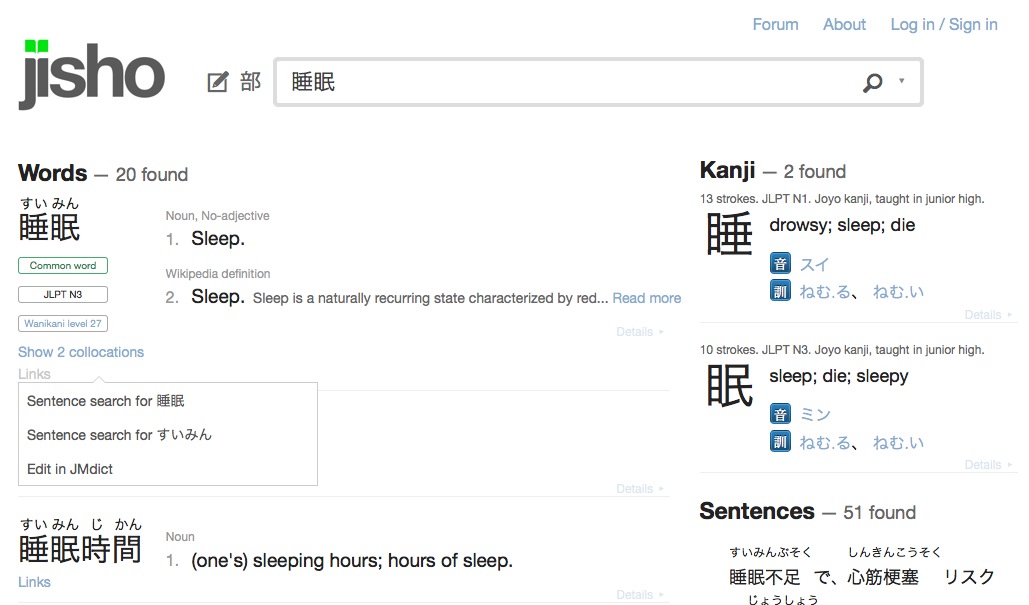
Denshi Jisho: New beta version

At first it looks comparatively stripped-down and one may wonder if it has all the functionality of the old version.  In fact it does, though it takes a short time to work out where things are now. It also has various functions it lacked in the past.

New features of 2nd Generation Denshi Jisho

Collocations: This feature is definitely the top of my list. It is slightly tucked-away and many users may not be aware of it. You will be, and you should be.

Just above the “Links” button in the left column is a button saying how many collocations are found using the word. Click the link and a pop-up appears with the collocations – and, yes, you can use Rikaichan in the pop-up.
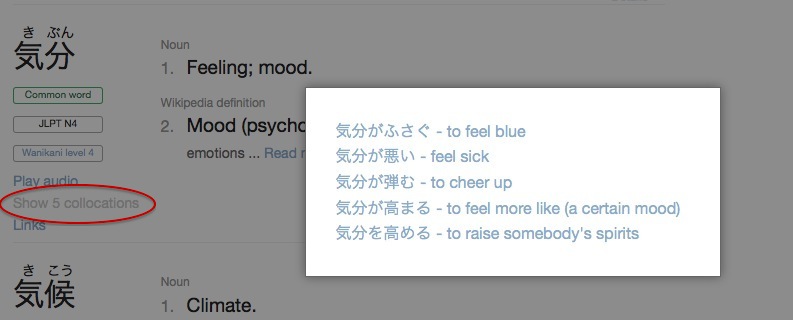
denshi-jisho-review

Collocations are a somewhat-neglected fundamental of language-learning, as I was recently trying to explain. A great deal of the time, a word is going to be found in a frequently-recurring collocation or (word-pairing or word-group). Don’t be afraid of collocations. They aren’t clichés, they are building blocks of language. Children often learn and use collocations before they become aware of the word-boundaries within them*.

Learn a word’s main collocations along with the word itself – it will give you a wonderful head-start in knowing how to use your vocabulary.

Collocations aren’t always that easy to track down (since they are still a rather neglected aspect of language) so having them built right into Jisho is a truly important development.

Kanji details: limited kanji details are now right there on the page. You can still click for greater detail and you will still need the Rikaichan toolbar (or at least its search box integrated into your regular toolbar) to get a quick breakdown of the kanji’s radicals. But it does inform you, with no further searching, about the component kanji of a multi-kanji words.

Sentence links: The link to the sentence database is not so immediately obvious (you have to click the “links” link to open the sub-menu). However there is one very useful change. You can now search for the word in either kanji or kana. This is convenient because Jisho always gives the kanji, so when a word is usually written in kana (you rarely see 有難う for ありがとう, for example) the sentence-finder comes up with no results until you retype it in kana. This little annoyance has now been resolved.

Wikipedia definitions: There are now Wikipedia definitions of words (in English) on the page – in case you didn’t know what the word meant even in English. There are definitely cases where this can be useful, though it is perhaps a little doubtful whether the extra on-page clutter all the time is really worthwhile for saving one the extra click to Wikipedia on the few occasions one actually needs it.

Inflections: There is now an on-page pop-up giving the inflections/conjugations of verbs and adjectives.
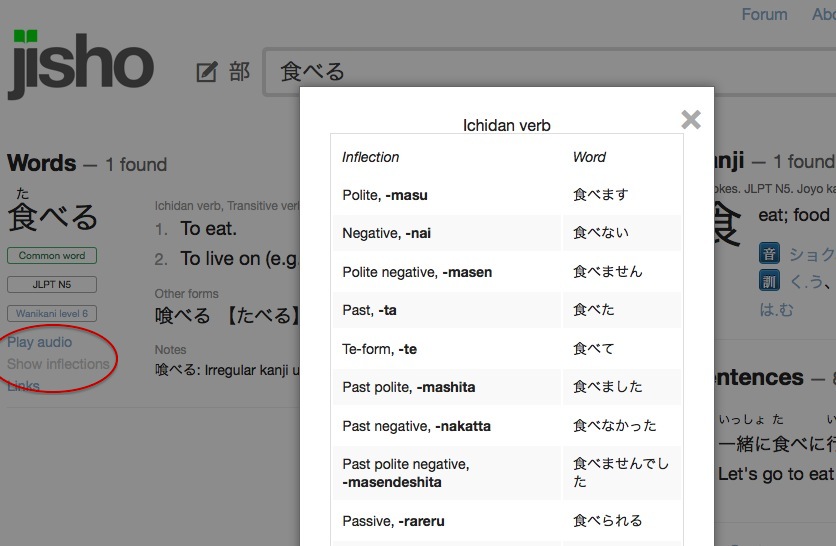
Denshi Jisho Update


At one time I used to search words on conjugation sites all the time. Japanese is so regular that this shouldn’t really be necessary, but I used to get confused and want to make sure. These days I almost never need to do this (if I’m at all nervous I type what I think it is and Rikaichan it), but for those at an earlier stage of learning this is likely to be very, very useful.

Single search-box: There are no longer separate search-boxes for English and Japanese – Jisho auto-detects language and even though it still allows mixed-language entries. This is more efficient as the cursor is always in the right box. Less clicking and no typing in the wrong box by mistake and wondering why you don’t find anything (or is that just me?)

Note: Multi-language searches are useful, for example, when you want “That word for contacting someone that has 連 in it”. Type “contact 連” into the box and you get 連絡 which is what you were looking for. It works if you only know the pronunciation – so “contact れん” will get you the same result. Unfortunately, in both old and new Jisho, it only seems to work with the first element of the word. “Contact 絡” (or らく)gives no result. Though, oddly enough, it still searches the kanji and in this case the first example sentence using the kanji uses it as part of 連絡. Okashii ne!

Audio: Many entries now have an audio button so you can hear the word spoken.

Furigana: Rather than have the kana in a separate column from the kanji, the new Denshi Jisho shows it as furigana over the kanji, while the kanji themselves are bigger without having to mouse over them. This is a better use of space, makes the kanji easier to recognize. Perhaps more importantly, the sentences section also features furigana now which makes the sentences much easier to read if there are a few unknown kanji

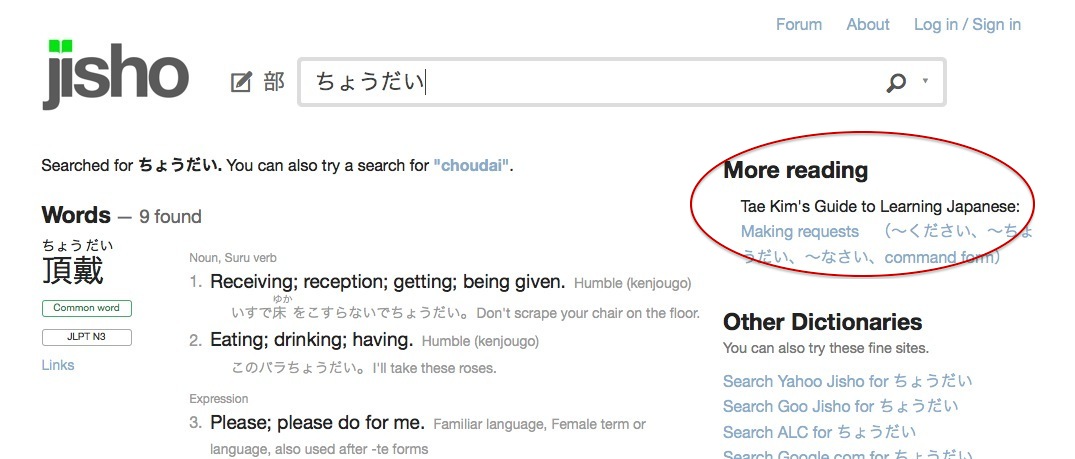
Other information: The new Denshi Jisho is an ongoing project currently in beta, so new things are still being added. The “more reading” section is a very welcome addition. Where words have special grammatical uses, for example, links are sometimes provided to Tae Kim’s excellent grammar resource:
second-generation-denshi-jisho-review

The stated aim of Denshi Jisho is to become an all-in-one learning and research resource and it certainly seems to be on the way to achieving that. There are a few areas in which the old Denshi Jisho is better. Currently, while one can filter searches in many more ways than before (click the down-arrow next to the magnifying glass in the search box) one can no longer search the names dictionary specifically (useful when trying to find names for characters in stories or RPGs).

To find the kanji-by-radical search tool, by the way, click 部 next to the search box. Why 部? I really have no idea!

Where the new Denshi Jisho could do better

There are a few minor minor problems. The inability to search specific dictionaries like the names one, as mentioned above is one. Another is the fact that where a word is written in different ways or with different kanji these are included as an addendum to the main entry rather than separate entries. While this is more efficient, it also means that there is now no separate indication of which kanji usages are common and which aren’t.

However this is an ongoing project still in beta and I expect these problems to be fixed over time.

The link to my favorite sentence database, Space Alc, is still there, though you now usually have to scroll to find it, under the kanji details and (somewhat unnecessary) first sample sentence. This is a minor inconvenience to those of us who like to move on from the definition to the large database to get the feel of how a new word actually works.

There is also now an indication of a word’s JLPT level. This is only a little useful for most of us, though I can see how it might be helpful for people actually planning to take the JLPT. However, the one missing piece of information I would really like to see is a ranking of the word’s frequency of usage. When learning vocabulary it is very useful to have an idea how commonly a word is used. The “Common word” marker is still there and I am grateful for it. There are about 6,000 common words and some of them are not all that common. I would really like to know which words are, say, in the top 2,000 – not because I only plan to learn 2000 words (I know rather more than that already) but because I really want to be sure I have the core vocabulary fully covered.

This may be more of a concern for autodidacts like this doll, but there are quite a lot of us and proportionately we are probably more likely to be reliant on online resources like Denshi Jisho.

The occasional foul language is still there. This is not good translation since equivalent taboo-words are not found in the same way in Japanese and taboo English is used to translate non-taboo Japanese, thus giving a completely false impression of the import of the words.

Besides this, even for people who think that only children should be allowed protection from mental pollution, this is an educational resource that will be used by children. This is not actually Denshi Jisho’s fault as the problem lies with the open-source databases it uses. We recommend the use of a profanity filter.

These matters aside, the next-generation Denshi Jisho is really an excellent upgrade. For my money, the addition of collocations is by far the most important addition and comes close to doubling the value of this dictionary all by itself. The inflections feature is also likely to be important to newer learners.

The other new features all add up to a better, more efficient, and more usable dictionary.

Our advice: switch to the new beta now. The link is in red at the top of regular Denshi Jisho.
___
* For example, a friend knew a toddler who used gubbadee (cup of tea) to mean “tea” and even referred to a “cup of gubbadee”.

How to Write Correct, Natural Japanese

Correct natural JapaneseAhem. Sorry for the rather audacious title, but there really is a way to write correct, natural Japanese.

I know people spend years learning to do just this, and I know there is no such thing as a get-fluent-quick scheme that actually works. But I am going to introduce you  to a power tool that, if you have a workable level of Japanese (upper beginner/lower intermediate), will make your Japanese writing far more correct and natural.

I am talking about Sentences. You probably already know that Denshi Jisho has a sentences section and you may be using it. But lot of people don’t realize how powerful this tool actually is or how to use it to best effect. There is also a much bigger database of sentences at Alc. I use both of them all the time.

2019 UPDATE: Another very good database can be found at Weblio. I consider this superior to Alc and unless you are already in Jisho (when using the sentences link under the Links dropdown may be more convenient) I recommend Weblio as the first port of call. Also, don’t forget to use quotes on your Japanese searches. Weblio in particular will often return some results irrelevant to your search without quotes.

Suppose you are writing a story or a post in Japanese. You have some idea of how to say what you want. But is that really how a Japanese speaker would put it? Or are you writing Eihongo (the counterpart of Japlish).

Video version

Can those words actually be used in that way in Japanese? What one should do now is try to find a precedent for the way you are saying it.

So if you think you know how to express what you want but aren’t sure that it is natural or correct Japanese, enter the key phrase into the sentence search box of one or more of the engines recommended above (or use a regular search engine if your Japanese is good enough) and see how it is actually used.

Cut it down to the basic turn of phrase you are worried about (these are databases of human-made sentences, not translation engines [thankfully], so you won’t find your exact sentence). See if that combination of words is in fact used with that meaning and nuance.

You can do this with very limited units such as てばかり – essentially asking “show me the way ばかり is used with a verb in て-form”. As you see, you can use this for elucidation of grammar points in a more general way, but what we are doing here is trying to find out if the way we are using it in our particular sentence is going to be natural, correct Japanese.

We can also expand it a little. If the word we are coupling with ばかり is very common, we can try putting in that exact combination and see whether it is used and how.

Of course if the phrase is not in the database it does not mean that it isn’t usable (though if you are using Google raw, it probably does), but it is a large database, so if the phrase is a common collocation, it is likely to be there. If it isn’t there it may be worth considering re-phrasing with something you can be more confident about.

You can also work the other way and put in the general idea you want to convey in English and see what Japanese examples you get. Expect to sift through various non-relevant examples. Be prepared to expand and contract your input (whether in English or Japanese) since if it is too long and explicit you may not find it and if it is too short it may not be explicit enough.

Remember also, when faced with pages of examples, most of which are not relevant, that a good way to sift through them is to use your browser’s on-page search function. Search in the language you didn’t input into the database in order to narrow down the results to your target meaning. For example, if you are wondering whether – and how – you can use 代わりに in the sense of “substitute”, you can search 代わりに which on Space Alc gives you six pages of results. You can then enter “substitute” in your browser’s page-search to look for examples of the usage you want.

Language works a lot by collocations – words that are continually found together. You make a fuss, but you throw a tantrum and you get into a bad mood. The phrase-elements are not interchangeable. Much as (Western) people may want to think that their own speech takes the form of personally unique combinations of words, in fact it is built up of countless collocations, or word-groupings that belong together and sound odd and “foreign” if different groupings are used.

Japanese is the same so what you are doing here is searching not only for correct grammar but natural collocations – the words that actually habitually go together in the language, and not only broadly mean what we are trying to say but convey the correct tone and nuance.

I confess I am a little “obsessive” (to use the pathology-based argot of current English) about looking up collocations and phrases. If I don’t remember a turn of speech from somewhere I try to find a sentence-example. If I can’t do that I usually consider re-phrasing.

This is not really “obsessive”, however. It is how you use English. In English you are continually guided by precedent. You know which words go together and which don’t.

Even sub-standard, ill-educated English goes by precedent. Very few native speakers over the age of six actually make their own grammatical mistakes. They use the bad grammar of their group. Large numbers of English speakers say “it don’t make no difference” but only infants and foreigners say “it not make difference”, or indeed any other variation on the phrase. Real, natural language is ruled by precedent at every turn.

Japanese speakers, of course, generally believe in precedent and conformity in speech. English speakers are prone to believe they hate conformity, but they are in fact just as precedent-bound as any other linguistic group.

So what I am saying is that you want a precedent for what you say. It is how natural speakers speak. Native speakers have an internal bank of precedents. We are using an artificial bank to simulate the same process and use correct, natural Japanese.

Fortunately, using this helps us to build our own internal bank too. The effort of researching the right way to say a thing helps it to stick (put it in your Anki too if it seems appropriate)

One caveat though. As far as possible, try to construct the phrase first. Putting what you want into the database in English can be useful but should be your last resort. As far as possible use words you already know even if it means simplifying your meaning a little. If you have to search in English, try to select from the results a Japanese phrase that you understand well. Don’t dump a chunk of blind-faith grammar into your writing.

There are a lot of reasons for this. Your writing should stay yours. It should be constructed of elements you understand and have control over. Otherwise you may be building a Frankenstein out of half-understood parts.


See – The Dangers of Dictionary-Dumping (using words straight from the dictionary)


That being said, the use of sentence-searching to enhance your writing will help you to use natural, correct Japanese better than any other single tool. Precedent is how language is built up in the child mind. Using it is the most organic way of expanding your use of language.

Of course you will be using native materials to build a true bank of precedent. More and more you will know how to say something because you recall this character in that anime saying something along the same lines. Online sentence-databases are a substitute for the one we will eventually, like all fluent speakers, be carrying in our hearts (I don’t say “heads” because I believe our hearts is where we truly carry them).

Just use the database method in as pure and organic a way as possible, and you will be writing natural and organic Japanese to a far greater extent than would otherwise be remotely possible.

On Learning a Second Language without Having a First Language

japanese-second-languageMiss Geneviève Falconer once said: “Most English-speaking people would benefit immensely from learning a first language”. The witticism is apt and much appreciated, but in my case it is more literal than it was ever intended to be.
As a space alien (as one of my fellow exiles so amusingly puts it) I am very aware that English is not really my first language, although currently it is my only language (I have a smattering of a few other languages, but am not yet fluent in any). I write books in English, so I suppose, up to a point, I have gotten into the cage with the chair and whip and made the language do some of the tricks I want it to do. But it is really not my language.

There are many things I want to express, and I kind-of know the words for them but those words don’t exist in English. It is an interesting challenge to try to force and twist the language into expressing what I need to say, and I don’t claim not to enjoy it, at least upon occasion. I am in the unusual position of having a native speaker’s facility with the language, but not a native speaker’s culture and sensibility, and to be actuated by thoughts and feelings that do not seem to belong in English at all. It really feels like speaking a second language while not knowing more than snatches of my first language.

Language does not exist in a vacuum. All languages ultimately derive from “the first, the mother language”. Just as “numbers were before there were things to be numbered” (a saying from my homeland), so words were before there were incarnate beings to speak them. Just as music derives from the Primordial Note and descends via the unheard Music of the Spheres to the realm of things palpable (or in this case, audible), so language derives from the Primordial Word and descends via the unheard Language of the Angels to the worlds of incarnate souls.

The languages that beings speak are formed by centuries of thinking and feeling. Languages, like all things have a warp and a weft – a vertical and a horizontal dimension. The vertical dimension of the fabric of language is the Primordial Language, without which no being could speak a word. The horizontal dimension is what happens to language through its exposure to the world of flux and change. This, of course, includes the special character of each dialect, or “language” into which the Primordial Tongue is broken, which is shaped by the particular character of the collectivity that speaks and forms that dialect. So English has its own particular character, as do French and German, Japanese and Chinese and all the other languages of this world and of all other worlds. Each one corresponds to a particular “genius”, with all its strengths and weaknesses.

No serious philologist doubts that the “progress” of language is a degeneration. The earliest known languages are the most complex, subtle and sophisticated (compare Sanskrit to Hindi, Latin to its various modern derivative languages or ancient Greek to modern Greek – or any other like comparison you care to make). That the implication of this is “down from the Angels” rather than “up from the apes” they naturally avoid, for this would conflict with the current ideology of their world, but the fact that the entire known history of language is a history of decline is indisputable.

This is not to denigrate modern languages, since the decline is a part of the process of manifestation, and to a degree what languages lose in depth they gain in breadth – a poor exchange but one that is metaphysically necessary. My own is no exception, of course. Modern Western languages, though, and English in particular, have been shaped by centuries of de facto materialism and individualism. As such it is about as far from the sensibility of my people as a language can get. It makes me wonder why I – like several others – was deployed in the Anglosphere, though doubtless there are good reasons. It certainly makes the expression of the thoughts and sensibility that I have to convey a little more challenging.

On a personal level, it also very much increases my sense of isolation – which I suppose is not necessarily a bad thing (except from the standpoint of my own humble emotions) since I am not supposed to “go native” – and going native is near-to-inevitable in a life-deployment unless one is provided with unusual circumstances and a teflon soul. Both of which seem to have been the case with me.

I have had an opportunity to observe the effect of language as a “filter” for the manifestation of a soul in a dear friend who is an American English-speaker but fluent in Japanese. Her English-self is beautiful in a way that is rare in these times, but her Japanese-self is something else – something more beautiful and more true (I believe) to who she really is.

Japan has long been cited as something of a this-world analogue to my home nation (by no means an exact analogue, of course, since the all-possibility is limitless and the exact same Form does not manifest twice). I had always accepted that, and have always been somewhat fascinated by the Japanese language.

But in seriously beginning to learn it I became for the first time aware that there might actually be a language that allows my soul to be filtered into manifestation in a way closer to its true nature than is made possible by its current linguistic medium.

Time for the Great Experiment.

The Best Firefox Profanity Filter

Firefox profanity filter
Kawaikunai ne!

What does a profanity filter have to do with kawaii Japanese?

Well, coarse language is not  kawaii. Some people think the two things can go together, and if you are the kind of person who likes to put detergent powder in your cake mix I guess they can. Whether anyone sane would want to eat the cake is another matter.

If you are serious about learning Japanese, you are using Firefox. Rikaichan is absolutely indispensable. There is a Chrome version called Rikaikun, but it is very much an inferior port. This means we have no real choice of browser.

Actually I don’t have that much trouble with foul language on the Web, but then I lead a very sheltered life, even virtually. Unfortunately though, even Denshi Jisho uses it – sometimes translating neutral Japanese words (Japanese does not have curse words in the Western sense, whatever foul-language disciples try to tell you) with taboo Western ones, which, apart from anything else, is clearly just bad translation.

So for this and a few other reasons, we do need a profanity filter, and I have had difficulty finding one on Firefox. There is a strange one that does not run natively (it requires something called Greasemonkey) and is made by extreme Christians who have blacklisted just about every word that can ever be used in an indecent sense. That includes a fair bit of the English language.

Fortunately a friend introduced me to Procon Latte which incorporates a profanity filter. It is very effective and user friendly, even if you have your interface in Japanese.

Procon Latte is not just a Firefox profanity filter though, it is a family tool that blocks websites, and can be a bit painful with false positives, apparently. So unless you have children or have a problem with accidentally ending up at bad sites (I use Ghostery to block redirects), it is probably best to turn off everything but the profanity filter.

Procon-latte-firefox-profanity-filterIf you have your interface in Japanese (if not, why not?) and you have difficulty with the options panel, the general options pane should end up looking like the picture here (click for larger image).

Once you have it set up, it is very smooth and you can even customize what it replaces bad words with. The default is !*#@!# or something like that. I have it set to 汚い言葉.

You can edit this and the language-blacklist by clicking the fourth tab along the top (with the speech bubble – in Japanese 悪口リスト). The blacklist itself is far saner than the competition. It is perhaps a bit too short, leaving out some of the unequivocally nasty variations on a theme of foulness that get used by unequivocally nasty people.

You can edit the list yourself, or we have an expanded list which you can import if you wish.

To install the enhanced profanity filter blacklist:

1. First install Procon Latte itself. In Firefox go to Tools > Addons (ツール > アドオン)and search Procon Latte in the toolbar. Follow the directions to install it.

2. Download our profanity filter settings file, and unzip it.

3. Go to the very last Item at the bottom of the Procon Latte control panel (a drop-down button – you can see it on the screenshot above) select “Import settings” – in Japanese 設定をインポート – and select the file you just unzipped (it is called procon.txt).

It really is as simple as that. This will give you the settings we recommend (profanity filter only) plus the expanded blacklist which will catch more genuine foul language but does not censor everyday words. Of course if you wish you can change the settings and re-edit the blacklist yourself after you have done this to get it to your liking. Be warned: the blacklist isn’t very pleasant!

Since it is called Procon Latte we thought we should mention the cons as well as the pros (we’ll even serve some virtual latte – hai, douzo). There is really only one, other than the slightly inadequate blacklist. Like any profanity filter we know of, it cannot work in non-html environments like Twitter or Rikaichan’s pop-ups. Rikaichan actually has its own option to “Hide X-rated entries” but considering what this doesn’t hide, I’d hate to know what it does.

That isn’t really Procon Latte’s fault, and it is currently by far the best Firefox profanity filter available.

Common Fallacies in Japanese: Oishii means “Delicious”

The feast. Deeply bound up with the concept of oishii.
Gochisou – the feast. Deeply bound up with the concept of oishii.

The translation of Japanese words into English words is often a bit rough, because precise equivalents frequently do not exist. For example, suki doesn’t really mean “like” and wakaru doesn’t really mean “understand”.


Learn Japanese easily


These commonly used “definitions” may in many cases be the word an English speaker would use in the same situation but they don’t work quite the same way grammatically or mean precisely the same thing.

I recently realized that the common translation of the word oishii to mean ”delicious” is also incorrect. Western people sometimes complain about the over-use of oishii in Japan, saying that it is too general and says nothing about what kind of delicious. The reason for this is that it actually does not mean delicious at all. What it means not easily translatable but is along the lines of: “enjoyable – (but only in connection with eating or drinking)”.

One can for example say that a restaurant is oishii. If one translates that as “delicious” it is absurd. We don’t eat the restaurant. But what it really means is “it is an enjoyable eating-experience”. I attended a very formal home celebration in Japan and afterwards said it was tanoshii (fun/enjoyable). A Japanese person who was meue (in a superior position) to me corrected me. I should have said oishii. This is because there is always a right adjective for particular situations. But the reason it was right was, I think, that it was an enjoyable experience involving food – but a little more serious than tanoshii would imply*. In English “delicious” would not only be grammatically and semantically incorrect to describe the whole occasion but would also imply a rather gluttonous attitude to it. But oishii does not mean delicious.

Kakigoori in the rain - still delicious, no longer oishii.
Kakigoori in the rain – still delicious, no longer oishii.

Another example. In Shirokuma (Polar Bear) Cafe a kakigoori (shaved ice with syrup) party that everyone had looked forward to was held on a balcony. It began to rain and although the balcony was covered, it was cold and damp. The characters ate their cold kakigoori but did not enjoy it much and one commented that kakigoori is not oishii on rainy days. Everyone agreed. Of course the rain did not affect the taste of the kakigoori but it did affect the enjoyability of eating it, and of the occasion on which it was being eaten.

Oishii was the right word. But “delicious” would have been quite wrong.

There are, of course, many occasions when the translation “delicious” works – which is how the misunderstanding arose, presumably. We can say oishii ryouri, and it is reasonably translatable as “delicious food/cuisine”. Even then we should be aware that it has a much richer coloring than merely “delicious” and, depending on the context, will imply to a greater or lesser extent “food that will give rise to a wonderful experience in eating it”.

This in miniature shows why translations of Japanese can’t help being “wrong” and why learners need at some point to start learning Japanese words themselves rather than learning the nearest English equivalent


See also:

Urusai: What does it really mean?


_____

* The non-use of the expected oishii could also have implied under-appreciation of the sekkaku tsukutta cuisine. Again because oishii is not “delicious” it would mean in this context “an enjoyable occasion involving excellent food”, rather than tanoshii which would leave, perhaps rather pointedly to a Japanese ear, the food out of account.


Kanji: What the (Western) “Experts” Can’t Tell You

To anyone reasonably well versed in traditional metaphysics, the meaning of some of the basic kanji is immediately and transparently obvious. Unfortunately, Western writers on kanji origins, armed with the beloved “progress” ideology and a total ignorance of traditional thought, work hard to obscure this. Let us try to set the record straight.

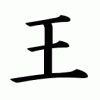
monarch-kanjiThe traditional explanation of the kanji for “monarch”[right], for example, is that of the joining of the three worlds of Heaven, Earth and Humankind. But really anyone conversant with the traditional concept of monarchy would hardly need to be told this any more than she would need to be told that a circle with two dots for eyes and a line for a mouth meant “face”.

The “monarch” kanji shows the World Axis, common to all traditions, joining the three worlds  – Heavenly, (or solar/Spirtual), Human, or (lunar/psychic), Earthly, (or substantial/material) – and thus reconnecting all things with their archetypal Principles and establishing the Law of Heaven on Earth through the mediation of the Axial being (in this world, the human), headed, of course, by its principal and representative individual being, the Monarch.

This is so elementary as to be the metaphysical equivalent of ABC [more about this].

face-kanjiSuppose some scholar were to tell you that the “kanji” to our left – which means face – was actually not originally a depiction of a face, but of a shirt button with holes for the thread.
It came to mean “face” because shirts button right up to the neck, near where the face is, but the supposed resemblance to a human face is pure coincidence, though possibly useful as a mnemonic.

The correct scholarly answer to that is: “pish-tosh”. Because even if it were true that the “face” kanji were originally a depiction of a shirt-button, it is absolutely evident that in simplifying and regularizing it, the scholars who did the work were, at the very least, utilizing a “visual pun” that clearly depicts a human face. Anyone who has an elementary-school knowledge of art can see that.

Unfortunately, many modern scholars, raised (or de-educated) in a tradition of pure materialism, do not have a knowledge  even that elementary of how human beings have actually thought for most of their history.

The current kanji for “monarch” may, as we are told, have had, as one of its ancestors, a “primitive” depiction of an ax. We do not dispute that at all. The ax itself is a metaphysical symbol, and one that is actually not unconnected with the symbolism of the current “monarch” kanji – that is, its haft is a depiction of the World Axis that connects heaven and earth as well as uniting the dualities of manifest existence (and the Western hermeneutic connexion between “axis” and “ax” is by no means accidental).

In reducing the kanji to its current form, the ancient daisensei were simplifying, clarifying, and, in a sense, universalizing the metaphysical symbol to one that anyone (except a person de-educated by the modern Western ideology) can read.

In many cases, it would seem that local and particular meanings – certainly metaphysical in their primary reference , as that is the way traditional people think all over the world – were reduced to a simple and beautiful geometric metaphor (and all “abstract” thought is essentially metaphor) that reduces the metaphysical narrative to its essentials.

The fundamental error of the “scholarly” approach is to assume that the earliest local and particular form that they can find is the “real historical origin” and that therefore the later simplification is somehow “inauthentic”, or at any rate “accidental”.

This in turn is based on the idea that ancient thought was actually trying to do what modern western thought is doing (ie dealing exclusively with the accidents of the material realm), only doing it badly.

Thus the only “root” a kanji (or any other word-form) can have is merely a matter of historical accident and not of the essential metaphysical nature of the word/concept. The lack of respect for the intellectuality of the daisensei who created the current forms of the kanji is at once breathtaking in its cultural arrogance and amusingly typical of the naive provincialism of Western (and Westernized) materialistic “scholarism”.

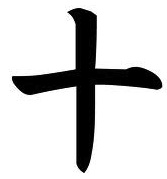
kanji-juuTo take one more example, we are asked to believe that the kanji number ten (juu) is unrelated to the essential symbolism of the cross and is merely an “accidental” simplification of an earlier form, influenced by the kanji for a sewing needle.

It would seem pointless to ask if it is mere coincidence that the Roman symbol for ten (X) is also a cross. The grasp of why the cross would represent ten is, in the minds of the modern scholar, so tenuous that coincidence would seem almost possible. You may wish to read this article to understand a little of the intimate connexion between four and ten, and also why ten thousand (万 man) is a numerical unit in both Chinese and Japanese.

Once we learn to discount the cultural arrogance of Western scholarism and gain some respect for the traditionally established forms of the kanji, they may begin to seem a little less mysterious. Ironically it is precisely the de-mythologization and “accidentalization” of modern Western thought that makes them seem random. In order to understand, we need to re-mythologize the kanji – or rather to treat the existing mythic/iconic structure with the respect it deserves.

What Kind of Japanese do you Want to Learn?

...but why would I want to stop sounding cute?
…but why would I want to stop sounding cute?

I rather unusually spent some time browsing around about-Japanese websites recently, and found some interesting things.

One was that, looking at sites that recommend partial immersion (as we do), there is often quite a strong desire to reach fully-native levels of Japanese and lose all trace of accent.

One prominent blogger, speaking of older Japanese learners, said:

 While [their] Japanese is “good”, their pronunciation still sounds very foreign, they make many mistakes, and they don’t yet have that natural flow. I believe that you, the next generation of Japanese speakers, will be different.  You won’t be satisfied at average.  You will join the ranks of the few and bask in the rewards.

It is a laudable aim, but it caused me to pause and think, what kind of Japanese do I actually want? Do I want to sound completely native? My English doesn’t sound completely native, and it is the only language I currently speak well. I don’t pass as native anywhere – in English-speaking  countries, strangers always ask me what country I come from.

I have spent time on language exchanges, helping Japanese people with their English. Some of them also express a desire to sound completely native. I do not believe they will ever achieve that. They are too far from it and not immersed enough to learn the hundreds of thousands of tiny things that need to become second-nature before you sound native. Heck, I haven’t absorbed them myself (that “heck” was a conscious affectation. I don’t naturally use these native colloquialisms!).

Also – and I am going to get very controversial here in some folks’ eyes – do they really want to lose all the little cute Japanese mannerisms and ways of expressing things that give them such charm?

Now I know a lot of people do. I have seen an English-speaking blogger touch precisely this point (that Japanese people, even if they will correct you sometimes, won’t correct the things they find cute). Well, I can see how some people might not want to sound cute. Personally, I spend a lot of time trying to sound cute in English. Why would I want to throw away my natural cuteness in Japanese?

All this comes down, I guess, to the question of “what are your real aims in learning Japanese?” For some people they are very practical and quantifiable. For others they are less clear. One thing that I think can happen is that having started on a course of improving one’s Japanese (which of course is what you have to do for a long time before you get even remotely competent), that quest becomes endless. Like rich businessmen who have made enough money that there is really nothing they actually want that they can’t buy, but continuing to make more money has become an end in itself.

I am not criticizing this – either for businessmen or language learners. All ends are, in a sense, arbitrary. Wanting to make more money when you don’t need it is no more irrational than wanting to capture the opposing king in chess or wanting to hit a white ball into a hole (actually I can think of metaphysical symbolism in both those acts that is lacking in money-making, but even so…)

What do I want out of Japanese? I am still not sure. But I don’t think it necessarily entails speaking Japanese in such a way that people think I am a native if they have their eyes shut.* As much as anything, I want to enter a new soul-world, and one that to me feels closer to my real native one than the English soul-world does.

In many ways it is a kind of rebirth. Many of my activities have reverted to a more child-like level. If I can’t watch a show in Japanese, I can’t watch it. If I can’t play a game in Japanese, I can’t play it. I don’t do those things in English any more. In certain – quite large – areas of my life I now act as if Japanese was Language per se and there is no “other language” to fall back on.

I want to communicate in Japanese and experience a Japanese way of seeing. All this entails getting a lot better than I am. It does not necessarily entail native level. I am interested to see how Japanese changes my thinking and in some cases how it enables thinking that feels natural to me but is inexpressible in English.

Currently I watch anime for children and read children’s books. In a way the logical progression would be to graduate to adult ones, but frankly – while I certainly want to get to a more sophisticated level than I am at now – I am not interested in adult books and movies in English, so why would I be in Japanese?

I express quite sophisticated thoughts in English, I guess. Do I want to express those same thoughts in Japanese? I am not sure. Maybe they will be different in Japanese. I am interested to see where Japanese leads me. Maybe Japanese will want me to attain native levels in all areas. Maybe it won’t. In Japan I was content to let Mother Japan lead me. I am also content to let Mother Japanese lead me. I am determined to improve my Japanese. I am not particularly determined to lose all trace of accent or even necessarily to read newspapers (which I don’t in English). I might want to keep a level of simplicity in Japanese that I have lost in English.

But in the end it won’t be what I want of Japanese, but what Japanese wants of me, that determines things, I rather fancy.
_____

IMPORTANT NOTE
* I think my regular readers know me better than this, but just in case there was any room for misunderstanding, I am absolutely not saying that it doesn’t matter how you pronounce Japanese. Talking Japanese with English vowels, timing and intonation is horrible. Of course one should be striving for correct pronunciation. What I am saying here is really only addressed to very high-level perfectionism – and not to criticize it, only to give my own – probably quite odd – thoughts.

Japanese Learning Tools – the Timer

One of the tools in your Japanese toolbox – especially if you are a self-learner – should be a timer – or more than one. If you are taking classes you have the discipline of set tasks and homework. By yourself it is easy to lose track, waste time reading English sites about Japanese (gomen gomen) and generally not really know how you are doing. At least in time-terms timers can help with this.

You should set aside time for practicing things like reading and listening, and it is surprisingly difficult to accurately assess how much you are doing if you don’t time it. Right now I am having a campaign to improve my kikitori (hear-catching, or listening comprehension) which is decidedly my short suit in Japanese. I am putting in three hours every day, and I need to keep track of that time. The best tool I have found for the job is the online stopwatch.

Why do I recommend this one? There are occasions for a count-down timer (I’ll mention them in a moment), but if you are trying to track a daily target it is better to have a count-up timer. This one can be stopped and resumed as often as you want, so you can get to your target in increments. Even if you close the window it will remember your time when you go back to the site (if you haven’t stopped it it just keeps on ticking), and if you are by any chance actually dumb enough to reset the timer by accident (like – ahem – certain dolls) it still keeps a record of your recent times in the slots below the stopwatch.

Japanese learning timer

I’ll be frank and tell you that I am a terrible record-keeper. At the start of my campaign I set up detailed record-blanks for myself to record exactly what I did every day. Guess how long that lasted. Some folks can do things like that and some folks can’t. Dolls are notorious for not. However I found this timer keeps as much record as I absolutely need – an idiot-proof track of exactly how long I have spent on my campaign-listening each day.

Another good feature of this timer is that it displays the count-up in the tab, so if you are working in another window you can still see your time progress at a glance.

A count-down timer is useful when you, say decide on an hour’s reading or listening right now. You can set the timer and tell yourself you won’t stop till that ping goes. There are several good count-down timers online or you can get a physical one.

Here’s mine which I got in Japan and love to pieces:

100_3360

As you can probably guess I use it to time reading sessions – not because I regard reading as a chore, but because I have so little sense of time that it is useful to decide to read for an hour or a half-hour and actually know what is happening.

Being shaped like a bear or other cute animal is not absolutely necessary, but highly recommended.

Japanese Kanji for World and Kingdom

The Sacred Monarch: uniting the three worlds

Today let’s look at the kanji for world and kingdom.

A friend watching Doki Doki Precure with Japanese subtitles was becoming a little confused by various words for world and kingdom, so let’s look at the basic ones. What do they mean, and how do we remember them?

As usual, let’s look at them in the light of traditional symbolic thinking.

The word for “world” is 世界 – sekai. It consists of two kanji: 世 se meaning “generation” and 界 kai meaning world.

se shows a mother holding children* – generations. It has other pronunciations and related meanings (world, society etc.) but its root-meaning is generation(s). The pronunciation is really a gift (at least in 世界) because it looks similar to せ and that is exactly how it is pronounced (it is theorized that the kana せ is actually a simplification of the kanji 世 ).

kai means world. This is a very fundamental kanji. There are two great symbols for the world (cosmos) in traditional thought. One is the house – the house is always a microcosm of the universe, with the hearth-fire as its central sun (heart). The field is the symbol of the world seen as the “field of action” (this is fundamental to the symbolism of the chess-board), or as the “place of growth”, or manifestation.

As you see, these two fundamental world-symbols, field and house, make up 界 kai. 界 only ever has one pronunciation, so if you want a mnemonic you could say “the world is not quite the (heavenly) Sky – so we cut the S off and just say kai”.

These two kanji together make the regular word for “world”, 世界 sekai.

The word for “kingdom” is 王国 oukoku.

ou means monarch. It is such a fundamental concept that it has no consonants. It is just pronounced ou. To understand the kanji we need to understand the concept of the Sacred Monarch, who occupies the middle position betwen World and Heaven, mediating between them. The Sacred Monarch (originally a Sacred Queen, later a King) carries the Mandate of Heaven and mediates it to Earth. The kanji 王 ou depicts this [for much more on this kanji and concept, please see this article (note that the kanji reading there is Chinese not Japanese)].

kuni/koku means “country”. Here we see the Sacred Monarch surrounded by what she rules. In traditional thought a realm is precisely the Sacred Center and its periphery. Without the Sacred Center there would not be a realm or country but a mere wilderness.

The kanji 玉 is actually not 王 the Monarch herself. It means ball or jewel. The Crown Jewel, and the Crown itself, is what adorns the Monarch and is often used as a synonym for the Monarch or her rule (terms like “property of the Crown” are still used in English). We could go further on the meaning of the Jewel as the Central Treasure (the Jewel in the Lotus) but that would be too much of a digression. What we should note here is that once we grasp the centrality of the Sacred Monarch we can see how Jewel and Monarch are closely related concepts. The jewel is a small-thing** that represents all the splendor and centrality of the traditional Monarchic concept. Therefore the kanji for jewel shows the Monarch 王 with a small-thing 玉. It implies both the small-thing that adorns the Monarch and the small-thing that is in itself Monarchic.

So the country, an ordered- or ruled-place (kosmos as opposed to kaos), is represented by the periphery with its central monarchic-jewel -  国.

We may also note that the kanji of 王国 oukoku, kingdom can be reversed to give us 国王 kokuou the Monarch of a country.
____

Notes:

* While generally means world or generation, the connotation of mother-like care is not completely absent. 世話 sewa means caring-for or looking-after.

** Smallness is symbolically important, as “the Jewel in the Lotus” represents the Center that is not extended quantitatively into manifestation, but upon which all manifestation depends.