A doll friend of mine has just made a video explaining how to pronounce the u sound in Japanese.
The difference between Japanese う and English U is actually very straightforward and easy to achieve if you just understand the difference. Strangely, this information is relatively scarce, so do watch this video.
To learn and maintain Japanese, or any other language, one must must develop a study routine. If one is in a class, some of this routine will be provided, such as assigned homework and test preparation; however, classes do not last forever, and to keep a language, one must use it.
Learning a language is not just one skill, but many. For this reason, it is important to have a well balanced routine. While the different skills build on each other, I have found it necessary to make sure that each skill gets at least some attention, and to grow in a skill one must practice and use that skill. For example, listening is very helpful to one’s speaking ability; however, one is never going to become proficient in speaking unless she actually spends time speaking. It is as simple as that.
So, how does one decide what practices to use? It can be a matter of trial and error, and one’s routine may, and indeed should, change over time as one becomes more proficient. Something may become too easy to be useful anymore, and something else that was too difficult early on may become useful over time.
In my own routine, Anime watching plays a central role. I use it in all different ways, and I have found ways to make it useful for every skill (except handwriting). For me, each way of watching develops different skills.
Below are the ways I watch, and the skills that they develop:
Slowly and carefully, with Japanese jimaku (“subtitles”), as described by Cure Dolly. This practice develops my vocabulary, kanji recognition, reading, reading comprehension, and grammar. On the other hand, for myself, this method does very little for my listening ability. I find that when watching this way, I am concentrating on the written word, and I barely take notice of the spoken words.
With Japanese jimaku, at full speed, with preparation. Because of the difficulty I described above, if I watch an Anime slowly and carefully, I always watch it again with jimaku at full speed. This matches the words that I have previously read and studied with the spoken word. It also serves as a review of everything I studied and researched during the careful watch. I have discovered that I get the best results when I do this at least one day after my first watch, but still within a few days. This way there is time for the new words and expressions to cycle through my Anki at least once, but it is still fresh in my mind.
With Japanese jimaku, at full speed, without prior preparation.I started doing this because there were only so many series I could manage at a time using the slow and careful method, and there were a lot of series I wanted to see. Yet, unexpectedly, I have found that watching some series this way develops some rather important skills, such as reading speed and the ability to understand what is going on from context, even when one does not understand all of the words. This is also useful in associating the spoken and the written word, because in order to keep pace with the action, one must use spoken and written cues. On the other hand, this method is not very useful for learning grammar or vocabulary. It does review the vocabulary and grammar one already has, though, and really forces one to use those skills at a real pace, rather than a practice one.
With English subtitles. As I discussed more fully here, I have found some limited use for English subtitles, although really this is the least helpful way of watching. I think that to be of any use at all, it must be accompanied by another form of watching. The uses I have found for English subtitles are to check my comprehension after watching with Japanese jimaku and to prepare to watch jimaku nashi (without any subtitles). The best time I have found to watch with English subtitles is a day or so after watching with Japanese jimaku (with or without preparation) and a day or two before watching jimaku nashi. I only include this step for the series I watch with my spouse (who is not studying Japanese).
Jimaku nashi, with preparation. For any show I watch with subtitles, I include a final watch jimaku nashi (without subtitles). For me, this is an essential step in the process. This reinforces everything I have previously studied in prior watches, and in my mind, this is the only time I feel like I am really “watching” a show, rather than “studying” a show, which is important in and of itself, I think. Everything prior is preparation for watching it jimaku nashi. While eventually one will want to be able to listen and understand unprepared in real time, I think that this is a later skill. I think being able to understand after preparation is a stepping stone to being able to understand unprepared.
Jimaku nashi, with no prior preparation. I tried this in my early days of Anime watching, but not for long. The reason for this was that I was not really getting anything out of it. I could pick out a few words here and there, and I would find myself making up little stories about what was happening (rather like a small child). After about six months of working with Anime, I could manage something for small children, like Anpanman, and have a general understanding of what was going on. Yet, now after over a year of watching Anime, I tried this again with Go! Princess Precure, and I found that I really did understand most of it (which I was able to confirm afterwards, when I watched slowly and carefully with jimaku). I tried this with a couple of harder Anime as well, and I understood less, but enough for it to be useful, I think. I still think that it is important to use the other methods I described to work on other skills, such as vocabulary building and reading comprehension. On the other hand, I think I am now ready to add this practice to my Japanese study routine.
Audio only. Lastly, I take select episodes and put them on my iPod to listen to over and over again, with only the audio. Usually, these are my favorite episodes, but they may also be episodes with important vocabulary. In the beginning, I chose episodes with a lot of singing to help with my pronunciation and ability to form morae, which are different than syllables. I found that singing along was extremely helpful. Now, I have about 30 episodes on my iPod, which I cycle through, usually using about about 2 episodes a day. This is almost completely passive learning, which I do while doing other things, such as housework. I think that the passive component is really important, because it allows Japanese to slip in at a deeper level than active learning does. It brings Japanese to the level that one does not have to think about it.
I have also recently found another use for the audio only component. I recently learned of the technique of shadowing, or trying as much as possible to talk along with the characters. Pronunciation is my weakest skill, so I am using shadowing to work on this skill. While this would be impossible with an unfamiliar episode, I have episodes on my iPod that I have been listening to for over a year, so much so that I almost know them by heart.
This probably sounds like a lot of work, and it is. I get enough benefit out of it, that for me, it is worth it. I hope that some of these ideas are useful to the reader.
There are various ways to learn about Japanese but only one way to learn Japanese.
Learning about a language is what you do with textbooks, classes etc.
It can be useful in helping you to learn Japanese. But learning about a language won’t in itself make you learn the language. That is why most people who learned about French or Spanish in school can’t speak it. That is why most Japanese people who do years of compulsory English barely know it beyond a few phrases.
To learn a language as opposed to learning about it there is only one way. You have to use it. Not practise it. Use it.
What does that mean? You are practising a language when you engage in staged activities purely for the sake of the language. You are using a language when you are doing things you would still be doing even if you were doing them in your native language. When you are actually making it your means of communication or understanding.
We have always advocated using Japanese by watching Anime (with or without Japanese subtitles), playing games, reading and other activities.
When you use a language you take a drop in “age”. You are limited in what you can do by your ability. This can give you a huge incentive to improve. You are doing what all small children do: struggling with language itself. Learning to understand and grow. Not dabbling in a “subject” through the medium of your native language.
Anime, games, books, manga and the like are excellent ways of using Japanese. However, they all have one thing in common. They constitute passive use of the language. You are receiving plenty of Japanese input, but you are not communicating. You are not engaging in the give‐and‐take of communication that is the primary function and the lifeblood of language.
The Cures at this site have communicated regularly in Japanese since early on in our Japanese adventure. However, there seem to be relatively few online opportunities to do this. There are dozens of sites for chatting about Japanese in English, but really nothing much for learners who want to use their Japanese. That is why we are trying right now to put that right.
Why such sites don’t exist seems to be for a number of reasons. The main one (and I suspect the others are often rationalizations of this) is that people are more comfortable talking in English about Japanese. Of course they are. Using language is about getting out of your current comfort zone and slowly establishing a new one in Japanese (but having said that, our solution tries to make using Japanese as comfortable as it can be).
If the minute you put your textbook (or even your manga) down, you snap straight back into English, even when you are thinking about Japanese, your chances of really learning it are minimal.
So how do you start communicating in Japanese?
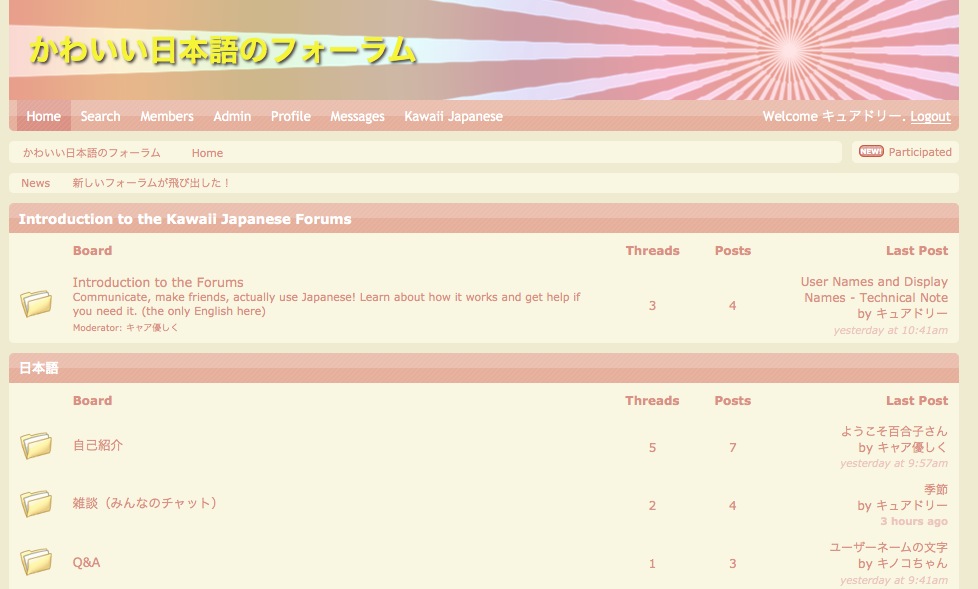
Our proposed solution is The Kawaii Japanese Forums. The purpose of these forums is to create a safe and gentle place where you can discuss anything and everything in Japanese. Talk about games, share music videos, compare the seasons in your part of the world with those of other members. Whatever you like (so long as it’s polite).
This way you start actually using Japanese interactively. If it goes well we may start Skype meetings where people can chat via voice. But don’t get scared. You can stay with nice safe text forums as long as you like!
A few questions about the only way to learn Japanese
Q. If I am talking Japanese with other non‐Japanese people may I not cement in mistakes?
A. This fear is common and rather exaggerated. We discuss it in detail here. Briefly it is much more important to use language than to worry about a few mistakes. Mistakes are part of the learning process. One should avoid them if possible but not be paralyzed by them. If you wait till you are perfect to use Japanese actively, the chances are you will wait forever.
Q. How early should I start actively using Japanese?
A. How keen are you to learn? You will get most out of the forums if you are upper beginner or above, but we Cures all started actively using Japanese before that. You learn by doing, and doing also makes theoretical learning easier. However, to participate before upper beginner level will take a lot of ganbari. If you are thinking “that sounds too hard”, it probably will be. If you are thinking “I’ll give it my all and manage somehow” then you probably will.
Q. Is there anything that can help me in following the Forums?
A. Yes. we recommend installing Rikaichan or Rikaisama. This will help you with words or kanji you don’t know. We also recommend a screen magnifier. Kanji at regular text size can be difficult to read when you aren’t very used to reading Japanese. This can help a lot.
Q. Ok. I’m on my way. Where were those Forums again?
Drama Club begins with Amenbo no Uta (Heartcatch Precure, Ep 16)
The Amenbo no Uta is sometimes recommended as a way to improve one’s Japanese pronunciation. However, it can do more than that. It can also improve one’s ability to hear and comprehend the language.
But what is the Amenbo no Uta? It is a nonsense poem that is used by just about all Japanese speaking professionals as a daily warm‐up, from news‐readers to voice actors (and very likely politicians too). While it reads like a stream‐of‐consciousness dream‐sequence, there is method in its words, but not narrative method. Its aim is to drill all the sounds and combinations of Japanese.
It runs to a very strict rhythm, and this is particularly important for the Japanese learner.
One of the problems, not only with speaking but also with hearing, is that we post‐process what we hear rapidly and immediately. For first‐language comprehension this is very useful. We are able to hear all kinds of strange accents, mumbled words and distortions and adjust for them, processing them back into the sounds they “ought” to be.
However, when we hear foreign sounds, we process them back to the nearest familiar equivalent, often helped in the case of Japanese by Romaji transliterations, which also represent the nearest English language equivalent. So we hear し as shi, for example (in fact it is neither shi nor si but a sound that does not exist in English). This doesn’t matter too much for comprehension or comprehensibility, though it is good if we can overcome it.
More important is the fact that the English sense of rhythm is radically different from the Japanese, and this does make Japanese very hard to hear. Our brains are attempting to post‐process what we hear into something English‐like that is very different from what we have heard.
That is one great importance of shadowing. It forces us to say, and therefore become aware of, what we are actually hearing, not what our brains want to post‐process it into.
Reciting the Amenbo no Uta can also help with a very important aspect of this: Rhythm. English is a stress‐timed language, while Japanese is mora‐timed. A mora is not actually the same thing as a syllable. This statement sometimes puzzles people, but I believe we can demonstrate here exactly what we mean, using the Amenbo no Uta.
First of all, I would like you to read and listen to the first four verses. They are written in kana. As you may know, every kana corresponds to exactly one mora (ex cept the small versions of the three y‐kana: ゃ,ゅand ょ which always combine with い‐row kana to form single‐mora glides: きゃ, りゅ, ちょ etc.)
Here is the reading, at a relatively slow “training speed”:
あめんぼ あかい な
あ い う え お
うき もに こえびも
およいでる
かき のき くり のき
か き く け こ
きつつき こつ こつ
かれ けや き
ささげ に すを かけ
さ し す せ そ
その うお あさせ で
さしました
たちましょ ラッパ で
た ち つ て と
とて とて たった と
とびたった
I think you can hear the very regular rhythm:
1234 1234
12345
1234 1234
12345
Each mora is a beat of the poem (and you will also find this in most Japanese songs).
So here is why a mora is not a syllable. We have a very good example in the first line:
あかい な akai na (1234). English speakers are prone to pronounce and hear this as a 123 “ak eye na”. Because in English the diphthong ai (often spelled “I”) plus any attached consonants is one syllable, eg. “time”, “mind” “sky”.
In Japanese there are no diphthongs. Japanese あい is not the one‐syllable English sound “I”. It is two morae あ and い. It is the same if a consonant is attached:
かい is か+い: two morae.
あかい is あ+か+い: three morae.
This is why it is important to read Japanese in Japanese script.
Going back to the beginning of the line, we are prone to read あめんぼ (1234) as amenbo (123). It doesn’t help that that is how it is written in Romaji, but we would do it anyway because that is how English works. We post‐process what we hear into something we are used to hearing rather than what we actually are hearing.
So already, unless we are attuned to the rhythm of the poem we have 123 123 instead of 1234 1234 for the first line.
あめんぼ is four kana and four morae. a me n bo. ん is always a mora of its own. Japanese people always think of it that way. If a Japanese person says bangohan to you and you don’t catch the word, she will repeat it slowly and carefully:
ba n go ha n (12345)
pronouncing each mora separately.
Fortunately, for much of the poem morae and syllables are the same, so we are able to catch and hold the rhythm easily. But the places where they aren’t are very important. By using this exercise regularly and getting it into one’s blood, one begins to feel the mora‐rhythm of Japanese. Once one has that, the language becomes more hearable. Naturally the Amenbo no Uta should be combined with listening to regular Japanese (your favorite anime is fine, so long as there are no English subtitles).
To round up a few more common difficulties in these first four verses:
We are prone to hear さしました sashimashita (stung) as sashimashta (1234). This is not exactly the fault of Romaji (though the kana tell us how many morae there really are). Most Japanese speakers suppress the second “i” sound almost completely, if not completely. But even if it is completely suppressed it still takes up a mora.
This is another way morae differ from syllables. A mora does not have to contain much in the way of actual sound. It is a beat, whether fully voiced or not.
When saying the Amenbo no Uta you could emphasize this by pronouncing the word sashimashita with the second “i” vowel fully spoken. However, I would advise against this. It is important to practice giving full mora value to morae with no vowel.
A very similar consideration applies to the small tsu. The fourth verse uses several of these, and each time they occupy a mora (as they always do).
We may hear たちましょ ラッパ で tachimasho rappa de as 1234 123, but if we do, it is because we are not counting the gap between ラ and パ (marked by ッ) as a beat.
Because I am writing this, it tends to sound very theoretical. In fact it is quite the opposite. We are talking about the rhythm of the language. Its very heartbeat. You need to to feel this in your blood, not just know about it.
If you can chant Amenbo no Uta every day with its proper rhythm…
1234 1234
12345
1234 1234
12345
…you can safely ignore everything I have written here. You will be getting the language in a more natural way.
PS ‐ there is one line (only one) where the scansion is not regular. Once you have the feel of it you will get a little “glunk” (to use the technical term) on that line. Presumably it was caused by the exigences of getting all the sound combinations into one poem. It really is a 力作, or a tour de force as we say in ‐ uh ‐ English.
I will send an invisible winged Dollykiss to the first person to identify the “odd” line in the comments below.
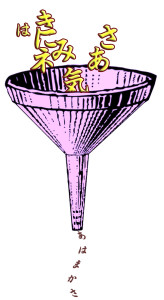
I recently discovered the Funnel Theory of language learning.
It came about when I was advising some beginners on learning hiragana. However, in this case learning hiragana works as a microcosm of all language learning.
The only way to learn hiragana is to plunge in and isshokenmei (with all your might) just learn it. It should take about a week. Two weeks at a maximum.
I have seen people pick at hiragana for months. They learn three one week and three the next week. By the fourth week they have half‐forgotten what they learned in the first week. These people may be shy of working at it, but they are in fact making a lot of unnecessary work for themselves. Learning hiragana is going to take far more work hours this way.
The thing to do is tackle it, bring it down, and then start using it. Because what you don’t use, you lose.
Here is the funnel theory in a nutshell. Think of learning hiragana – and this applies to language as a whole, as we shall see – as trying to fill a funnel with water. The fundamental rule of filling a funnel with water is this:
If you aren’t pouring it in faster than it is running out, you are wasting your time.
Hiragana is a small funnel, so we can see this at work. The pick‐at‐the‐edges learner is spending as much time re‐learning as learning.
Bigger learning tasks are bigger funnels. An entire language is a huge funnel. But the same principle applies.
Even with one’s native language, if one stops pouring in (using it regularly) one starts to notice the loss. It is subtle because the funnel is huge and the drainage is small. But the longer one stays completely out of contact with one’s native language the more one finds that when one does try to use it one constructs sentences in ways more appropriate to one’s everyday language, and sometimes gropes for everyday words.
In terms of actually learning a new language I would say that Funnel Theory, while always important, is most critical at two points. Early beginner and Intermediate.
In the early beginner stage if one is learning too slowly the funnel will never start to fill at all. It is draining as quickly as it is being filled and no water really accumulates. The funnel just gets wet.
Beginner stage is a danger point for learning and a lot of people drop out early on. They say “It is impossible”, or “I am not cut out for learning languages”.
And it is impossible. Impossible to fill a funnel at that rate of flow.
However, serious learners keep the flow high and learn quickly. We all have weak and strong points in language (learning a language is not one skill but several), but overcoming the funnel problem at beginner level is not difficult if one is serious about learning.
Intermediate level is the next major point at which Funnel Theory presents problems.
Intermediate can be difficult, especially for lone learners.
At beginner level, up to upper beginner, learning is very straightforward. There are certain things you need to know and lots of places that will tell you exactly what they are. You learn basic vocabulary which is again straightforward. No question that you need all the basic words in a language.
At intermediate it becomes much trickier. You know all the basic grammar, conjugations etc. Intermediate books (even upper beginner past a certain level) are collections of “grammar points”, ways of expressing different things, presented in no particular order other than roughly decreasing order of frequency in regular use. Vocabulary becomes more specialized. A lot depends what you need, what you are intending to use it for.
At this point, as at the beginning, it is easy for language to start draining faster than it runs in.
A serious student of Japanese told me before I even started that this stage is “grueling”. You just have to work, work, work till it hurts or you will fall back faster than you move forward.
Is this true? Yes, if that’s how you go about things. It isn’t how I go about things and it isn’t the way I recommend you do.
My serious student friend was just that: a serious student. To her, Japanese was an academic subject. One she was very serious about.
To me, Japanese is a language. My language. Not the one I was born with, but the one I love.
So let me say this. Intermediate is wonderful!
Funnel and all, it is wonderful.
Because at intermediate level you can really start using Japanese* and as long as you are using it extensively, that funnel is filling. I am not saying one should stop studying, but I would say that at this stage study becomes secondary.
In fact I would go further and say that if you are only studying, then unless you are doing it to grueling levels (like my friend), the funnel will start emptying faster than it fills.
But if you are using it. Playing games in it. Watching anime in it (with or without Japanese subtitles, but not with English ones). Reading books or manga in it. Holding regular conversations in it. If you are doing this then the funnel keeps filling. You also have some structure for learning. You learn the vocabulary and grammar you actually encounter.
You probably want some explicit study to help the funnel fill faster.
But(big, big but)
• If you have plenty of real use without the study, at this stage, the funnel will keep filling.
• If you have study without the real use, it is in serious danger of starting to drain.
This is bad news if your intentions with Japanese are not honorable. If you are merely dallying with her, your chances of retaining her are small.
But if you truly love her and mean to make her yours, it is very good news indeed.
* My fellow Cures and I forced real usage by pure ganbari long before we were really ready, and it did a lot of good. But intermediate is still wonderful because that is when it really starts to come into its own.
Over a year ago, Cure Dolly wrote a wonderful and helpful article about How to Learn Japanese through Anime. I have followed that method for almost a year myself, and I think it has really helped me learn. Watching Anime with Japanese subtitles is not my only learning tool, but it remains an important one. In that article, Cure Dolly discussed that using English subtitles is not very useful, and I agree with her.
The trouble with using English subtitles, aside from the translation difficulties, is that our minds are efficient, and despite our good intentions, will take the easiest route to understanding possible…which is English. For example, I have noticed that when I used to watch shows with English subtitles, when the theme song played in my head later (and it often did), I heard the music in my mind with the words in the English translation, even though I actually heard the song originally in Japanese.
This being said, there are some shows I still watch once with English subtitles. The reason for that is I live with someone who is not learning Japanese, and there are some shows I watch together with her. I think that there is an important strategic value to this. One of the things that attracts many of us on this site to Japanese is its culture, including the importance of community and family. Learning a language and using immersion really does require one to make adjustments to one’s life, and it is so very helpful to have the support of one’s family and one’s household. Sharing the shows that you are watching with one’s household can be a good way to solicit and encourage their support.
Aside from the social advantage, I have found ways to make this time useful to my studies as well, which may also be of use to some readers. First and foremost, anything I watch with English subtitles, I watch again without subtitles. For kikitori (“hearcatching”), it is quite helpful to be able to anticipate what is likely to be said next. Even if I have only recently watched the show once with English subtitles, I can actually hear and understand much more when watching jimaku nashi (without subtitles) than I can watching a kinnie cold for the first time (or for the first time in a long time). I have done (and do) both, and there is a clear difference in what I can catch.
If Japanese subtitles are available, I watch the show with them before I watch with English subtitles. This increases the chance of me actually hearing the show in Japanese rather than in English. The mind is efficient, and it will rely on the memory of the previous work I did with the Japanese subtitles in understanding, as much, if not more than the English subtitles. This also gives me the opportunity to check my work. I can say…oh I did understand this….or oh dear, I missed all of that explanation.
This being said, use of English subtitles is a slipperly slope. In order to minimize the dangers, I have two rules for myself. I only use English subtitles when watching with someone else and never watching alone. If she does not want to watch the show, I do not watch it with English subtitles at all. Knowing this rule also gives my family member a sense of importance (she is helping me safely “check my work”). I can not emphasize enough that the more family support one can get, the better. I also do not give the show my full attention when watching with English subtitles. I do a lot of handcrafting, and if I watch a show with English subtitles, I work on a project at the same time. This means I am not looking at the screen the entire time, because I often need to look down at what I am working on, so that I need to rely on the spoken language from time to time.
Actually, as an aside, I have found that to be an interesting test of whether I am processing the show in English or in Japanese. Before I started learning Japanese, I would watch a show with English subtitles when doing other tasks, and I would find myself surprised that I would lose track of what was happening when I would look away. I would then remember…oh I am understanding through the subtitles, and not through what I am hearing. Now that I have learned much more, I do hear the Japanese when I look away (even if I do not understand every word). It is quite interesting really.
Dragon Quest VII. Tons of text but are JRPGs the best way to learn?
Can you learn Japanese with JRPGs? They can certainly help a lot, and I recently discovered a very useful though simple strategy for maximizing their learning potential.
Recently I have been playing the 3DS remake of Dragon Quest VII. I am adoring seeing Dorakue in 3D and finding the game very useful for learning. Dorakue VII is actually one of the best JRPGs to learn Japanese with because it is very text‐heavy.
In fact, Square Enix has currently no plans to translate the game into English because it has so much text that it would be unusually expensive to localize. An unstated reason, I suspect, is that Western RPG players have much less tolerance of extensive text (even in English, the lazy piffers) than Japanese players. A reviewer of the original Playstation version of this game is quoted on Wikipedia as saying that the first part of the game consists of “some of the most boring hours you will ever play in a video game.”
At my playing speed (very slow even in the old English days) it was ten hours before I had a fight. But these hours were packed with story. “Never mind the story, just get on with the game” is the attitude of many Western players, I think. No wonder the company is hesitant about a translation.
But I digress. The point here is that Dragon Quest VII has a lot of text. I recently came to the conclusion that the best Japanese games for learning were visual novels – the Professor Layton and Phoenix Wright games both fall into this category. Best because the proportion of text to anything else is much the highest. In Professor Layton one spends some time on puzzles, but the rest is practically pure text with pretty visuals. In Phoenix Wright the “puzzles” are part of the text itself, and you have to understand the witnesses’ stories in considerable detail to spot the 矛盾 mujun, contradictions in their accounts of events.
With Dragon Quest VII, even though it is one of the wordiest JRPGs ever made, one still spends a great deal of time fighting monsters. While there is a little text involved in the turn‐based fights (menus, descriptions of events), it is repetitive and brief. Not terribly useful for learning. Since you will be spending hours of your play time doing this, does that make JRPGs a bad choice for the learner?
My answer is no. In the first place, after visual novels they are clearly the second‐best option for reading comprehension purposes. There is a lot of text and it matters (if you don’t understand what a character is saying you may not know what to do next). JRPGs are good practice. It is just that with all the fights they aren’t constant practice. Except that…
The Dolly Secret to Learning Japanese with JRPGs
I just discovered a perfect way to make those fights play into your learning.
Numbers.
JRPG fights are full of numbers. If you are familiar with table‐top RPGs you can practically hear the dice rattling under the screen. And you can see the numbers too. Every time you hit an enemy or an enemy hits you, what pops up? A number. When you win, you are told the amount of gold and experience you just gained. In numbers. When you level up, you are given a string of numbers telling you which stats improved, by how much, and what they are now.
This is very useful for learners, even fairly advanced ones. The trick is to be disciplined and say each number, preferably aloud, when you see it.
“But I know Japanese numbers. I learned them in lesson 2, ‘way back,” you may be saying. Of course you know them. So do I. But how fast do you know them? Can you think in them? Can you see 32 or 469 and immediately see not “thirty two” or “four hundred sixty nine” but “san juu ni” or “yon hyaku roku juu kyuu” ?
That is what this exercise is about. Making numbers in Japanese not something you “know” but something you actually think in, as second nature and first language.
You may actually find the pace of combat too fast to do the in‐fight numbers at first. If so, just diligently say the 経験値 (experience points) and gold numbers that come up after each battle and the stats when you level up. You can take your time with these.
Work up to saying every number that comes up in a fight as soon as it appears. This requires a little 我慢 gaman, but you are thinking in Japanese culturally as well as linguistically, aren’t you? So 我慢 is becoming natural to you, isn’t it? You might make an exception for multiple hits (where an attack hits all or a group of opponents). I do, because I can’t do that in English (but numbers are my 短所 short suit in any language).
But what you are aiming at is the point where you can see a number in Japanese when your mind is in J‐mode. You aren’t thinking “thirty‐seven, oh that’s san juu nana”, you are thinking “san juu nana”.
It is tricky, because when Arabic numerals are used it is pretty much equivalent to reading a word in English. Your mind has mapped those characters to certain sounds. What you are doing is re‐mapping the Japanese numbers to your Universal number perception, just as learning Japanese should be re‐mapping Japanese to Universal Grammar. Most learners never do either.
But you will. With the help of JRPGs.
The only way to achieve such a radical re‐mapping is huge amounts of repetition until the new map becomes instinct. The same way that, if you touch‐type, endless practice taught your fingers where all the keys are, even when your brain can’t instantly recall the information. In other words, moving the Japanese number system from conscious recall to instinctive and instantaneous association.
Such practice in isolation would be mind‐numbingly tedious. But JRPGs will kindly throw an endless stream of numbers at you while you’re having fun. And you can turn what was wasted time from a learning point of view into highly valuable practice.
Even as your characters gain experience points with each battle and keep leveling up, so will you gain number‐remapping experience points with each battle and continually level up toward your total remap.
The Homophones: They’re alike, and that’s a good thing!
People often say “there are so many homophones in Japanese”. And it’s true. Japanese has fewer vowel‐sounds and far fewer possible syllables than most languages. So quite a few words are pronounced the same as each other.
This can feel confusing. But it can also work for you if you approach it in the right way. First of all, homophones are rarely actually confusing in practice. How much trouble do you have in English with “to”, “too” and “two”; “know” and “no”; “lie” (fib) and “lie” (down), for example?
Homophones aren’t really a problem. And as an English speaker you are already used to them. Some languages are less tolerant of them than English. In French, for example, the word for “yes” is oui and the word for “today” used to be hui (cf. Spanish hoy, German Heute). However, when French pronunciation changed and “h” was no longer pronounced at the start of words, oui and hui became homophones and the French could not bear the ambiguity. They started saying au jour d’hui ‐ (the day hui) for “today”.
If you’ve ever wondered why French has such an unusually long term for such an everyday (heehee) concept as “today” ‐ that is why. English, on the other hand, is happy with very common homophones like “to”, “too” and “two”. Speakers realize that in practice they aren’t usually confusing. So an English speaker really shouldn’t worry too much about Japanese homophones.
However, what one can do instead of worrying is make those homophones work for you. Because they can actually be very useful. You can use them to form mnemonics, but I often find that you don’t even need to do that. Often, just remembering that a word is pronounced the same as another word acts as a mnemonic in itself. The mind loves connections. Give it a connection, however odd, and it will tend to stick to it.
Quite often I check for homophones and will pop them in my Anki with a note “same pron” (I am too dumb to understand fancy words like “homophone”). And I find that very often, along with the word I will remember the “same pron” words.
Sometimes there is a long list of homophones for a word. Don’t pop them all in. They look scary, but in fact they will start to make more sense as you understand their structure ‐ why they mean what they mean. But pick one or two that feel nice to you. Rikaisama’s frequency information can help you to find the strategically most important.
For example, I was delighted to realize that 減少 genshou, “decrease, reduction” has the same pronunciation as 現象 genshou, “phenomenon”. I actually knew both words already, but realizing that they are homophones gives me a quick cross‐check when I am wondering if I have one exactly right.
If you want a mnemonic, just remember the law of entropy (or the “heat death of the universe”). All material phenomena are constantly and inevitably decreasing. There is also a 現生 genshou which is a Buddhist term meaning “the present world”. Frankly, I wouldn’t bother with that as it is very uncommon. However, if you do want to memorize it, just remember that the present world ‐ the one we incarnate beings live in ‐ is precisely that world of ever‐waning phenomena. Which is a very Buddhist point of view. And true.
Can you do this with other homophones? Certainly you can. As I said, you don’t necessarily always need to. Homophones, once you recognize them and note their curiousness, often stick by themselves. But, suppose you want to remember the homophones 機械 kikai, machine, 機会 kikai, opportunity, 毀壊 kikai, destruction and 奇怪, kikai, strange. Just remember that great technical progress has often come about in time of war and in military contexts. In other words: warlike societies see machines as an opportunity for destruction. I don’t know about you, but I find that rather strange.
Conversely, destruction has often been an opportunity for (the creation of) machines. Still equally strange in my view.
I recently encountered the word 生気 seiki, vitality, verve, vigor, while playing Dragon Quest VII. Now, the word makes perfect sense in kanji terms (life‐spirit) but for remembering the pronunciation on the fly (for example when talking or listening) it is also helpful that it has the same pronunciation as 世紀 seiki, century or era. For me that works as a straight cross‐check, though if you want a mnemonic, just remember how lively people are at the start of a new century. Like a New Year party on happy‐juice.
Now in this case there are several other seiki’s. This is the sort of thing that worries people, but in fact they are all very regular etymological combinations of easily‐understood kanji. If they look like a strange and random mare’s nest now, don’t panic. Just leave them alone for now and realize that they will make much more sense once you know more Japanese.
Most of them are quite particular and not necessary to know right now (if you are at the being troubled by them stage). The commoner ones are 生起 seiki occurrence, happening (kanji= life‐occur) and 性器 genital (kanji=gender‐instrument).
One thing you will note with all these (and if you want to look up せいき in Jisho, all the others too) is how very useful the Sound Sisters are. Nearly all of the pronunciations are aided by knowing them.
生気 has the Sei Sister 生, plus 気 which is nearly always ki (sometimes ke/ge)
世紀 has 世 whose on‐reading is regularly sei and 紀 which includes the Ki Sister 己.
生起 is the Sei sister 生 plus 起 which again includes the Ki Sister 己.
性器 has 性 which includes the Sei Sister 生, and 器 has the regular on‐reading ki.
If you look up the other seiki’s (there are ten and you don’t need to worry about them all right now) you will see that their pronunciations are all clarified by one or more of the Sound Sisters, and most have quite regular and understandable kanji meanings.
So you see how our methods work together to give you multiple “mind hooks” on a word.
The words we are learning (or consolidating) we can easily attach to the others of the same pronunciation. If you need mnemonics for the actual homophonity (to coin a word) they are easy too.
For example, with 正規 seiki, (Sei Sister 正) regular, normal, legitimate, we can remember that life and vigor in the West may currently be associated with unconventionality and “badness”, but in Japan it tends to be associated with being regular and legitimate.
An occurrence 生起 is clearly a vigorous movement of happening in the calm sea of being. If you want to associate genitalia with liveliness, I am sure you can. I don’t do that sort of thing. More seriously though, we are dealing here with the material source of life (do I think all these connections are mere accident? No, actually I don’t, even though some of them are just fanciful. But that would take us into subtle regions that are far beyond the purposes of this article).
Now seiki is one of the kind that worries people. Ten definitions for one word‐pronunciation. Just remember: you don’t need to worry about all ten at once. In fact you shouldn’t. The mind can’t really handle ten at once so you lose the mnemonic value of the homophone. Take one or two (probably three at the outside) of the most useful homophone‐partners of the word you are currently learning and associate them together; you can then add more at a later time if you want them.
It is good when you have multiple mind‐hooks working together. The homophone word‐group, the Sound Sisters, knowledge of the kanji and their meanings all work together, hooking meaning, sound and kanji from various angles.
Of course, the best “hook” of all is usage. Hearing them, reading them, saying them. But the other hooks are all important ‐ like the scaffolding that is needed until the building is complete.
Like scaffolding, it all interlocks, making a firm structure. Unlike scaffolding, while some of it will eventually go away (fanciful sound associations and such), other parts will become a part of the building (kanji meaning and word structure).
But all the scaffolding is important while the building is still being constructed. And homophones provide some very useful bars and struts (or whatever they call them) in that scaffolding.
Far from being your enemies, homophones are your friends and allies if you know how to use them.
We have written extensively about Rikaichan because in our view it is one of the most important tools in the arsenal (if you’ll excuse the mildly mixed metaphor) of an online Japanese learner.
Now Rikaichan has a big sister: Rikaisama. Not even Rikaisan. Sounds like a very big sister, doesn’t she? How does she measure up?
Rikaisama is essentially Rikaichan Mk 2. Still the Japanese dictionary add-on for Firefox that works the same way and keeps all your Rikaichan settings (in a few places she still refers to herself as Rikaichan) and looks just the same. Nothing has actually changed, but several things have been added.
Among these new additions, the most important are: direct on‐the‐fly addition to Anki, human voice pronunciation of words, Sanseido mode (optional Japanese definitions instead of English), pitch information, and new frequency information.
The direct‐to‐Anki feature is a blessing. You need to install the associated Anki add-on, but once you’ve done that, a single keypress while hovering over a word will create a card for it with the kanji on the front, kana‐reading and meaning on the back. You also have the option of putting the kana on the front. This is really useful and saves a lot of time. Apparently you can also add the sound of the word, but…
Actual native‐voiced audio readings are another important new feature of Rikaisama, but that has been rather disappointing to this doll as they just don’t seem to work with the Mac OS. Actually no OSX installation instructions for Rikaisama are given at all. I just followed the Windows instructions and it worked fine. There are special instructions for getting the voices on Linux, but it seems that on a Mac there is no way. Consequently I can’t review the sound. If anyone wants to add something on that, please feel free to use the comment section below. [By the way, Mac owners should not feel too short‐changed in the voiced‐Japanese department ‐ you still have the best Japanese voice synthesizer available].
Update: The current Rikaisama now supports recent OS X versions correctly.
Sanseido mode is very useful, I think. It allows access to the Sanseido (that big chain bookstore you see everywhere in Japan) dictionary. You were always able to turn definitions on and off, so you just got interactive furigana, but now you can also get a J‐J definition. You can switch between the three (E‐definition, J‐definition, and no definition) with a keypress. The only small drawback is that you can’t download the Sanseido dictionary, so there is a (usually very) small delay while it downloads the definition each time (and it won’t work at all offline).
You can also install Epwing dictionaries, but I am afraid they don’t work on Mac either, and I have no experience of them.
An important point is that if you are in Sanseido mode (and presumably in J-J epwing mode) when you do use the direct-to-Anki feature, you get J-J (Japanese word with Japanese definition) cards.
Whether you’re using J-J or J-E definitions, you can harness Rikaisama’s huge database of native-speaker recordings of the words and set up Rikaisama and Anki so that the spoken word is placed on the back (or if you want to make an audio-recognition deck, on the front). This is a truly wonderful feature, but unfortunately it is not at all obvious how to use it, so we have given full instructions in this article.
In addition to the old (P) used to indicate if a word is common (it is still there—Rikaisama hasn’t taken anything away from her little sister), there is more kuwashii frequency information in the form of a number that tells you how many words are more frequent than the one you are looking at (so 5 would be a very common word and 10000 would be a rare one). The number is also color‐coded: Green=very common, dull greeny-yellow=common, orange=less common, pink=relatively rare.
This more detailed Rikaisama frequency information is also taken from a different source from the (P) classification. Rather than newspapers, it is distilled from 5000+ novels. I find that reassuring as I don’t really find newspaper‐language all that useful. I don’t bother with the news even in English. This also allows a very rough cross‐check between two frequency assessments, which is also useful.
I have heard some folks say that since one aims to learn all Japanese words anyway, why worry about frequency?
The answer, in my view at least for those who are learning Japanese by self-immersion is this: The less skilled you are at Japanese, the slower you can imbibe Japanese media. Your aim should be to increase this speed as quickly and efficiently as possible. You learn words best when they are reinforced by real encounters with them (not just Anki encounters, wonderful as Anki is).
So, since you can only learn so many words per day, you should be concentrating on the ones you are most likely to re‐encounter relatively often. This keeps cementing your vocabulary base as it increases. No harm learning a few rare words (we all do it). But your overall strategy is best served by learning well‐used words first and slowly moving to lower‐frequency ones as your base grows. This way you are not only absorbing vocabulary, but equipping yourself to absorb more by increasing your ease of exposure to Japanese as efficiently as possible.
As your speed and volume of media consumption increases, your chances of re‐encountering less common words grows proportionately (at first it is very low because your consumption is so slow and limited). So tackling words (very roughly) in order of frequency makes good strategic sense.
Now I am not suggesting that you should be slavishly bound by frequency numbers, but they are definitely useful information to have and bear in mind. So this addition in Rikaisama is very welcome.
There are a few more additions, including pitch accent information, which the main online dictionaries do not supply.
One more clever addition is the ability to click the Heisig number of a kanji (usually from the Rikaichan toolbar or the more streamlined search‐box addition to your regular toolbar) and go to the Heisig mnemonic page. You have to be a member of the site to do that (it’s free). I joined just because of the Rikaisama functionality. I am not a major Heisig fan, but this is definitely a function that is worth having available.
All in all, I would say that the promotion from “chan” to “sama” is justified. This is not really a new Rikai; it is decidedly Rikaichan with several more tricks up her sleeve. But they are valuable tricks that really take an already valuable application to a whole new level. The direct‐to‐Anki function is worth the installation alone.
You need to uninstall your current Rikaichan in order to install Rikaisama, but don’t let that put you off. You won’t lose anything and you will gain quite a lot. And if you use Anki for vocabulary, I strongly recommend that you install the Anki add-on too.
If you don’t understand the full power of Rikai, I suggest you read our Rikaichan review. It was far more than just a quick way to furiganize kanji and look up words even before the new features were added. Because of the way it is structured it can answer many of your basic grammar questions on the fly, and is an invaluable tool for proofreading your Japanese writing. It is as much a writing tool as a reading tool.
And if you were starting to think you had outgrown J-E, Rikaichan just grew with you!
In the previous article on modern language acquisition theories, we learned how Universal Grammar forms the basis for a child’s initial acquisition of language and generally how that acquisition actually works. Now we can turn to the practical application of the science.
What do these language acquisition theories mean for the language learner?
First, they mean that age is not any kind of a barrier to language learning. After the age of around ten you can learn language equally well at any age. The deciding factors are motivation, amount of study, degree of immersion etc., but not age.
The current language acquisition theories also mean that you will probably not become fully “native” though you may get very near it. They also tell us what the key to this is:
The more you can map your target language onto Universal Grammar rather than onto your first language, the nearer you can become to native.
Now there is a balance here. Especially in the early stages, learning via a known language is a very important short-cut. Remember that contrary to popular belief, small children do not learn language quickly. The number of “study hours” it takes a small child to be able to express herself even rudimentarily is very large indeed. By mapping onto your already-acquired native language at first you can and do cut down this time radically.
Pseudo-immersion methods, like Rosetta Stone, which try to replicate the small-child-learning process fail for a number of reasons: there is no human interaction, it is not done for every waking hour, but primarily they fail and must fail because the user already knows Language. Whatever happens, she will be mapping what she learns onto her native language—just doing it very inefficiently. At the end of many, many hours she knows a lot of nouns, some verbs, and almost no grammar. If she doesn’t give up at that point, she will, very wisely, invest in a grammar textbook.
So do our language acquisition theories deny the possibility of immersion-learning for adults and older children?
Absolutely not. But these, I believe are the conditions:
1. If you can find a genuine 100% immersion environment—all Japanese all the time with complete isolation from your own language—then absolutely go for it. I envy you. You will learn even with no theoretical teaching—though it will take a long time and will actually be much faster if you have mastered basic grammar first. But having said that, it is probably the best way to learn.
2. Failing that, what can and should you do by way of immersion, and how will it work in accordance with our language acquisition theories?
Remember that our aim is, as far as possible, to map Japanese onto Universal Grammar and not onto English. You should start by learning the grammar through the medium of English (or your native language) because that quick-and-dirty shortcut will give you a big head-start once you begin the real thing.
What is the real thing? It will vary from case to case, but our aim is to think in Japanese, not to think in English and “translate” Japanese back to ourselves. To this end, we should:
a. Imbibe native materials (not for-gaijin Japanese) as soon and as much as possible. I have talked about how to do this via anime. Personally, I do not have any recreational activities in English. Japanese to me, outside of necessary English communications (like this one), is not “a language” but Language per se. If I can’t watch an anime in Japanese (with Japanese subtitles), I can’t watch it. If I can’t play a game in Japanese, I can’t play it. If I can’t read a book in Japanese, I can’t read it. I don’t allow myself any recreational English activity.
b. Talk in Japanese every day if you possibly can. Whether it is with Japanese friends or other learners. Some people worry about talking Japanese with non-Japanese people, feeling they may “learn wrong” or pick up mistakes. If you are doing a. you should be getting exposed to a lot of correct Japanese through that. But I also believe that even if you are picking up or cementing in some incorrect language that is not nearly as important as the fact that you are using Japanese regularly. Small children don’t always speak correctly, and often their conversation is with other children who don’t speak correctly. But they do use the language because it is, for them, Language per se—the only means of communication. So it should be when you speak Japanese: even if you both know English, if you can’t say it in Japanese, you can’t say it.
Ideally, it is good to have practice partners with whom you only ever communicate in Japanese. This is important not merely because it extends the amount of time you spend speaking it. The most important element is a subtler, but vitally important, psychological one. You are building a human relationship in which Japanese is the only language—Language per se. Language is the basis of our human relationships, and human relationships are the basis of our initial acquisition and continued use of language.
You see the pattern here. What you are doing is carving out areas of your life where Japanese is not a language but Language per se. You are not practising Japanese, you are using it. If you want to say something to your Japanese-partner friend you have to say it in Japanese because there isn’t another language. If you want to see a movie or play a game, you have to use Japanese because there isn’t another language. Your limitations in Japanese are your limitations, period—at least for the areas of your life that have become Designated J-Zones.
c. Think in Japanese. This is probably the hardest part but also the one that will most effectively map Japanese onto Universal Grammar rather than onto English in your mind. You need to begin putting your internal monologue into Japanese. If not permanently, then at least for designated periods. While this is difficult, it is very possible. You can “dethrone” English from its place as your thinking-language though it takes a lot of ganabaru and a spirit of taihen da kedo zettai ni akiramenai (I definitely won’t give up however tough it gets).
And it will get tough. English will try to hang on to its position as your representative of Language per se—or Universal Grammar—like grim death. Inch by inch you will have to force it out. The more you do this, the more your “first thought” is in Japanese, the more you are mapping Japanese to Universal Language directly rather than to Universal-Grammar-via-English.
By these methods you are forcing your mind, at least to some degree, to map Japanese to Universal Grammar (its root language model) directly rather than via English. Thus you will be using language acquisition theories to your advantage and absorbing and using the language in the most natural manner.
NOTE: Since writing this I have discovered that learning to think in Japanese is much less difficult than I made it sound here if you use the method I recommend. I don’t know if this will work for everyone but it has certainly done wonders for me.


 I recently discovered the Funnel Theory of language learning.


